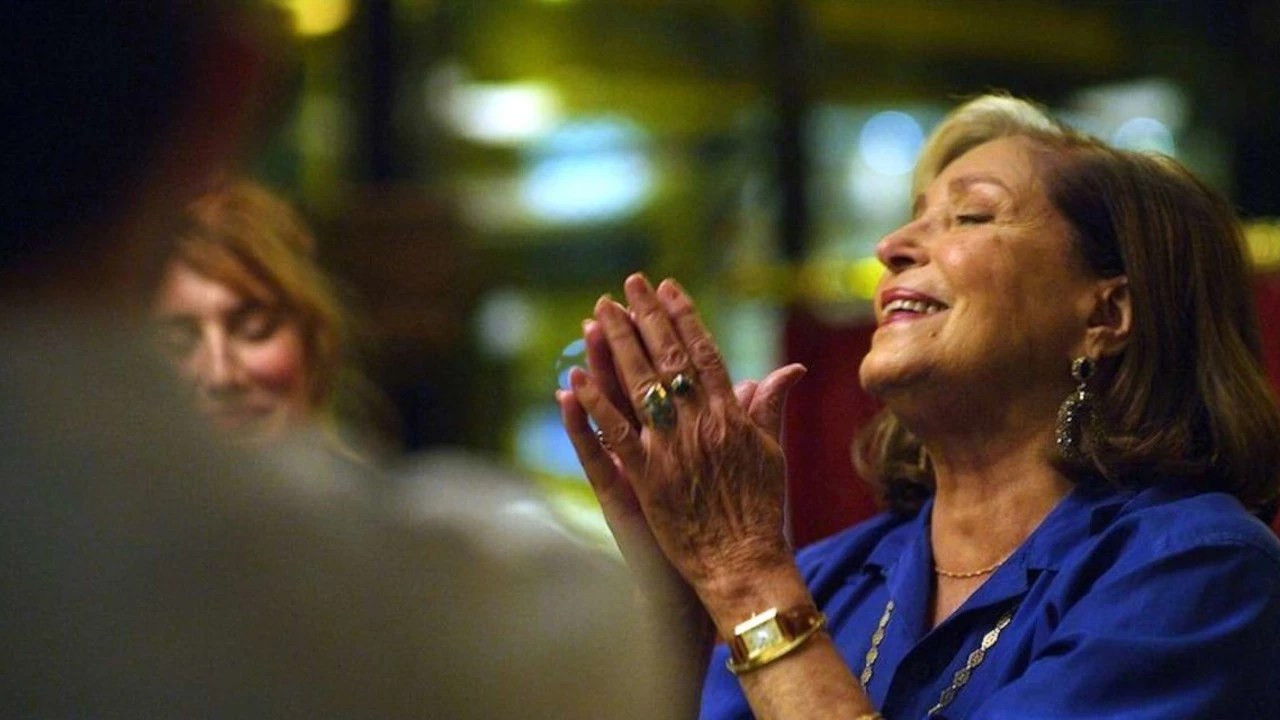
Rose (Françoise Fabian), the titular character, is a 78-year-old woman who loses her husband after decades of marriage. She rediscovers herself and redefines the meaning of womanhood in Aurélie Saada’s debut feature film, Rose. Throughout the film, Rose demonstrates a significant journey of self-discovery by opening up to others, while most crucially, she fosters a deeper understanding of herself. By this, I mean Rose learns how to have fun; drink a little vodka, smoke a little weed, and flirt with a bartender she catches feelings for.
Rose opens up at a party, which happens to be for her husband Philippe’s (Bernard Murat) birthday, where Rose seems to be having a ball. Rose appears to be the happiest she’s ever been, and this party signifies what her life is like and how joyful her life and her family bring her. Pierre (Grégory Montel) is the only one who knows the truth about Philippe, that he has been diagnosed with terminal cancer. This cancer is what later kills Philippe, leaving Rose on her journey that is this film.
Predictability is something that is very common in this film. There’s really nothing too exciting or new to Rose’s journey of self-discovery. One might find beauty in the seemingly simple plot, but it feels rather predictable, leaving a feeling that this story couldn’t be complete. I will admit, seeing Rose grow over the 100-ish minutes we spend with her is the most fascinating and heartwarming thing here. There’s a scene in particular, where Rose sits around a table with her daughter and her friends and she is asked what she does, assuming this question is asking about her profession or hobbies, but she responds with “I’m a widow”. This short yet impactful moment shows how death, especially the death of a spouse so close to you, can take over you and make it your whole personality. This evidently happens with Rose. This certain scene feels as if it represents Rose’s transition into prioritizing herself, amongst people who believe she should forever be sad and lonely.
Rose’s family, who happen to all be very important parts of the film, probably because each one of them is a big part of Rose’s life, also have their own issues occurring during this time of recovery for Rose. I mean, we’re seeing life through Rose’s lens, and we’re learning how to feel directly from Rose. These issues, which are lightly grazed over by Saada, are all biased events because we have seen these events the way Rose believes them. For instance, when Rose’s daughter’s ex-husband reveals he is having another baby, assumingly with someone other than her, that information feels irrelevant, almost like Rose is pushing it away.
During all of this chaos, Rose decides she needs to go out by herself and live her own life. While at a bar, she falls into deep conversation with the bartender, explaining all of her children’s issues, which all happen to be about love, as well as her own. This scene represents Rose as she finally discovers that she can be happy again and that she is allowed to go out there and meet new people because that’s probably what Philippe would’ve wanted anyway, a happy Rose.
What we see in this directing debut, which has been a festival holdover since the 2021 Locarno Film Festival, is how the plot of this film is Rose herself, as she battles, well, herself. It’s satisfying to just see Rose grow and redefine herself, no matter how upset her children are at her for doing so. This might not be the most action-packed or plot-induced watch, but Saada accurately and masterfully captures parts of the grieving process, as well as parts of growing up.
Rose was released on January 24, 2025, and is now playing in theaters limitedly.
 Wyatt’s Takes